A craft inherited by hand.
A discipline built by choice.
Roof Energy is a small, founder-led company that installs roofs, waterproofing, insulation, and timber structures in Attica — and refuses to do them any way but properly.
Second generation, different method
The craft in this company is inherited. It began with a man from a small farming village who left school early, went into the technical trades, and built a name the only way it could be built then — with his hands, one roof at a time, one recommendation at a time. That name carried a crew for decades without a single euro ever spent on advertising. It still hasn't spent one.
What the second generation inherited was the hands and the perception — the ability to look at a building and understand it. What it did not inherit, it built: the study. The methods used on Greek roofs thirty years ago placed thermal insulation between the tile battens, with no continuous insulating layer. It worked, to a degree. But the enemy of good is better, and better existed — in the sarking method, in double timber construction that holds the insulation like a sandwich, in a continuous thermal envelope with no interruptions. We studied the leading builders of the craft worldwide, tested the methods, and rebuilt our stratigraphy around them.
We called the result the energy roof — ενεργειακή στέγη. When the crew became a company, the name translated itself: Roof Energy.
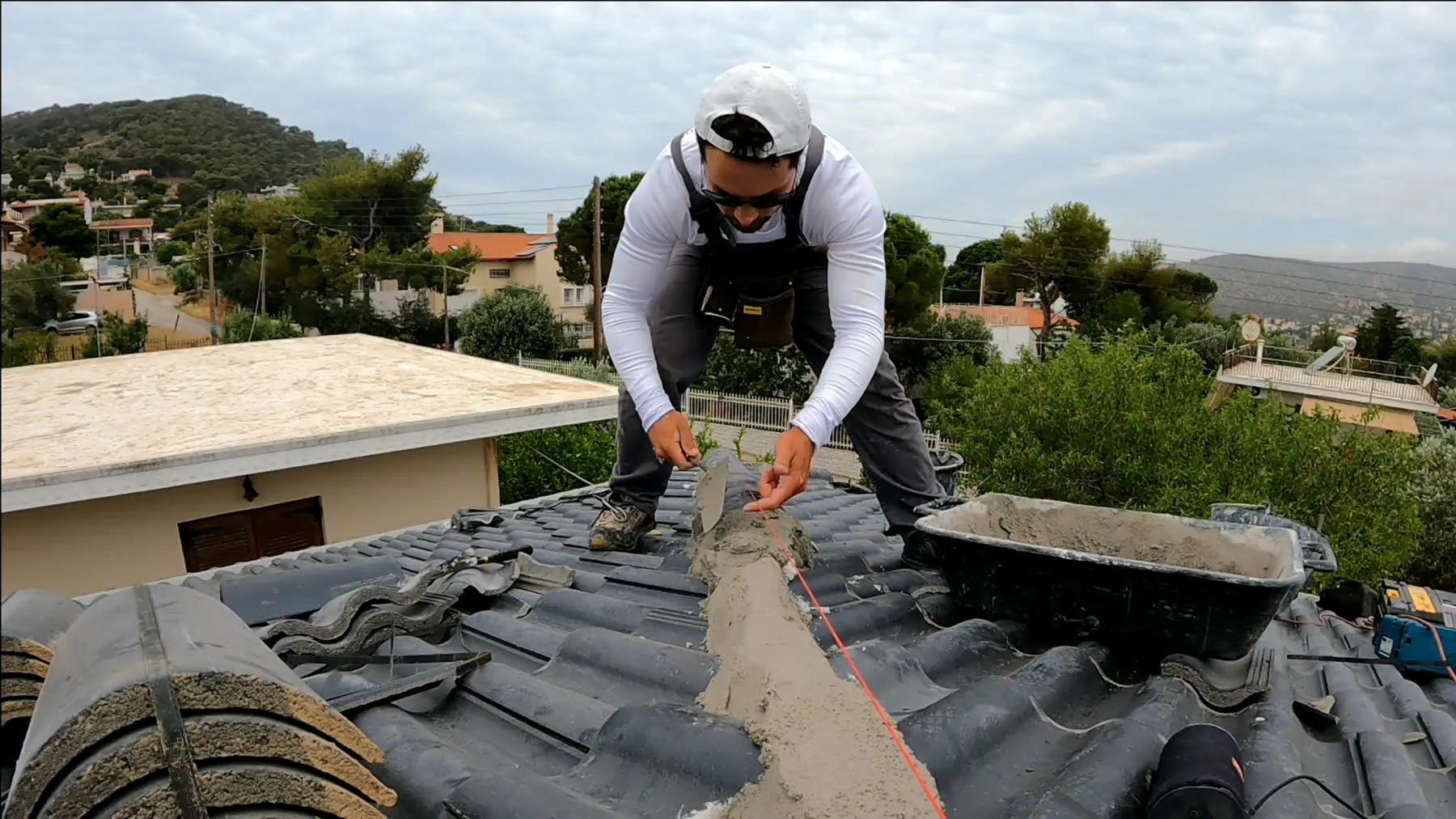
What we refuse
We do not do half-measures. A patch that hides a problem without solving its cause is not a small service — it is a false promise with our name attached to it. Clients sometimes ask for exactly that: a cheap repair, a quick cover, and — quietly — the transfer of responsibility for the whole roof onto whoever touched it last. We decline that work. Solving the problem at the root is not our premium option. It is the only option we sell.
This costs us. We have lost serious projects — including one worth over seventy thousand euros — because we refused to reduce the stratigraphy to meet a counter-offer at nearly half the price. Whatever was built instead was not built the way we specified. We can live with the lost revenue. We could not live with our name on the compromise.
And we do not quote frozen prices per square metre over the phone. A roof is not a commodity, and a number given blind is a guess dressed up as a promise. We look first. Then we put the scope in writing.
The crew and the standard
The crew is three men, the founder among them, with additional hands brought in when a project demands it. In a market where much of this trade still runs on informal cash and no papers, everyone here is formally employed, insured, and paid above what the market pays their equivalents. That is stated with pride, because in Greek construction it is not the default.
The standard on site starts from the founder and passes down. No alcohol — not a sip. No shouting, no swearing, no disputes. Mistakes are welcome; they are how the work is learned, and the founder is the first to say so. The same mistake made twice, unlearned, is another matter entirely.
Every new man who joins works to these standards from day one. They are not negotiable, because the standard is not a policy — it is the product.
The archive
Every project is documented from first day to last — photographs, video, timelapse, drone. Above all, the hidden stratigraphy: the layers under the tiles, the terminations, the membranes, the details that will be sealed away and never seen again. We record them all, and the client receives the record, at no charge.
This is not a marketing feature. It protects both sides. There is no fog over how a project was completed — no dispute about what was used, what was done, what lies beneath. And in ten, twenty, fifty years, whoever owns that building can open the archive and see exactly what these people did in there: which materials, which stratigraphy, which method. A roof outlives its contract. The record should too.
What "done" means here
The honest truth: the founder estimates a job at two or three days and it takes six or seven. Not because the work runs late — because "done" here includes the dozens of hidden details no one will ever inspect, and then the site itself: cleaned, cleared of debris, left better than we found it, with a result that stands technically and aesthetically.
We do not measure ourselves against the market. It would be easy to point at a competitor's work, claim to be somewhat better, and rest there. We measure against ourselves — against yesterday, against the last project — and ask what can be done better on the next one. That comparison never lets you rest, which is precisely why we keep it.
On every critical point — the timber cuts, the placement of a specific tile, the finishes, the final details — the founder is on the roof, hands on the work. The final word on every main element is his. That does not scale easily, and we know it. But we will not trade the technique for speed: we will work as long as it takes and use whatever materials it takes for the result to be complete.
What we promise — and what we refuse to promise
Clients usually arrive as strangers — cautious, guarded, sometimes hard in their posture, because they know how this market can treat people. What they meet is someone who can explain everything, document everything, and put every claim in writing. By the time a project is delivered, the guard is gone. Many of the people who arrived suspicious are, years later, greeted as friends.
What we promise is this: beyond the guarantees and the paperwork, we hold a moral obligation to stand beside our clients at any point in time — to come back, to advise, to be behind the work if anything ever arises. That obligation does not expire with the invoice.
What we refuse to promise is that everything will be perfect for decades. We build as if it will be. Materials move — heat, cold, expansion, contraction — and other hands sometimes pass over a finished roof and leave damage that looks like ours. Anyone who promises you perfection forever is selling you a sentence, not a roof. We would rather give you the honest version: built to last, documented to prove it, and backed by people who answer the phone.
If your roof needs attention, start with a site visit.
We arrive with instruments and leave with a written scope. That's the first step — not a price.
Contact Roof Energy